QuickArchViz vs mnml.ai: Which AI Rendering Workflow Is Better for Professional Architects?
Compare QuickArchViz and mnml.ai for AI architectural rendering, geometry preservation, camera consistency, studio workflows, iteration costs, and professional presentation visuals.
- Jowita Chmura
- Alternatives

Quick Answer: The Decision Matrix
Choosing a generative design tool for an architecture firm requires moving beyond basic feature lists. The real question is how the platform fits into the studio’s operating workflow, total cost of ownership, and need for architectural precision.
Choose QuickArchViz if you are a professional architecture firm using Revit, SketchUp, Rhino, ArchiCAD, Blender, or CAD/BIM screenshots and you need client-ready presentation visualizations that preserve building geometry, camera angles, and design intent. It is optimized for production workflows with a predictable pricing model: 1 Credit plus 2 Free Iterations.
Choose mnml.ai if you are in the early, unstructured phase of concept exploration, running broad stylistic experiments, or looking for an open-ended digital canvas to test many abstract aesthetic directions where geometric precision is secondary.
Strategic Overview
mnml.ai is an AI-powered architectural visualization platform tailored for early-stage design exploration. Its public site highlights 12+ AI-powered rendering tools, 40+ architectural styles, and unlimited design variations across sketch, exterior, interior, landscape, and rendering workflows.
QuickArchViz is a specialized cloud rendering workflow engineered for professional architectural presentation. Instead of acting as a broad playground, it works as a non-destructive rendering layer that helps architecture firms turn raw viewport screenshots into photorealistic, presentation-grade visuals while maintaining structural and perspective accuracy.
Core Workflow Analysis: Where the Platforms Diverge
1. Geometry Preservation vs Stylistic Fluidity
A common challenge with generalized AI architecture rendering workflows is that generative models can interpret precise structural components as flexible visual shapes. Window mullions may soften, roof pitches may shift, or vertical columns may lose alignment if the system prioritizes style over architectural constraints.
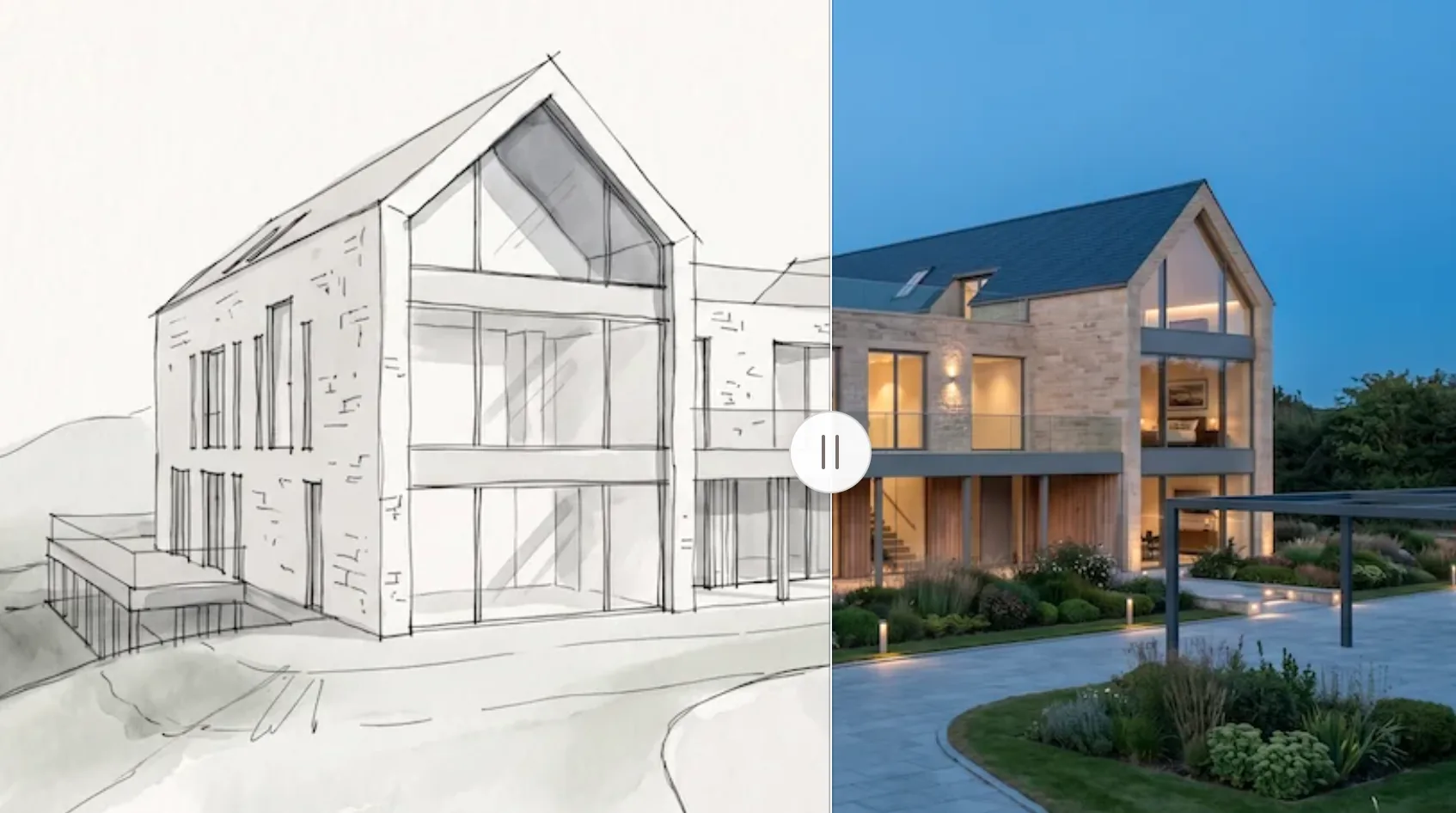
mnml.ai is strongest when high stylistic variance is the goal. That is useful for abstract brainstorming, but professional client presentation work often needs stricter control.
QuickArchViz focuses on geometry-preservation workflows. The rendering pass is designed to respect structural vectors, boundary lines, and depth relationships from the source image. When you render a SketchUp model, Revit view, Rhino viewport, or ArchiCAD screenshot, the physical architecture should remain the anchor. Materials, lighting, atmosphere, and context can change without moving the building.
2. Camera Tracking and Viewport Consistency
For client presentations and design board reviews, maintaining a fixed camera position across several options is non-negotiable.
If the horizon line, focal length, or field of view shifts between Option A and Option B, the comparison becomes less useful. The client is no longer evaluating material or lighting decisions from the same design view.
QuickArchViz is built around viewport consistency. Teams can render material alternatives, seasonal lighting shifts, facade options, or landscape treatments from the same camera angle, keeping side-by-side presentation boards credible.
3. Iteration Economics and Studio TCO
The cost of an AI rendering tool is not just the subscription fee. It is the operational cost of refining images until they match the design intent.
Changing an exterior wall from concrete to brick should not feel like starting the whole job from zero. QuickArchViz uses a structured iteration economy: 1 Credit plus 2 Free Iterations. When an architect generates a base view, the next two modification passes can be used to refine lighting, materials, or environmental assets without draining the monthly credit pool.
Operational Scenarios: Which Tool Fits Your Project Stage?
mnml.ai remains a good fit during the first week of a competition or concept phase. If a client asks to see a project imagined as brutalist, minimalist, biophilic, or futuristic before formal CAD work has stabilized, mnml.ai’s style breadth can help the team produce many conceptual moods quickly.
QuickArchViz is built for the production presentation phase. When you have an active model in SketchUp, Revit, Rhino, ArchiCAD, Blender, or another design tool and a tight deadline for a client presentation, planning submission, or marketing review, QuickArchViz helps bypass traditional V-Ray or Lumion setup work by turning a standard viewport screenshot into a polished 4K visual in under 60 seconds.
Screenshot-to-Presentation Pipeline
The QuickArchViz pipeline bypasses manual UV texturing and complex lighting setup through a streamlined three-step process.
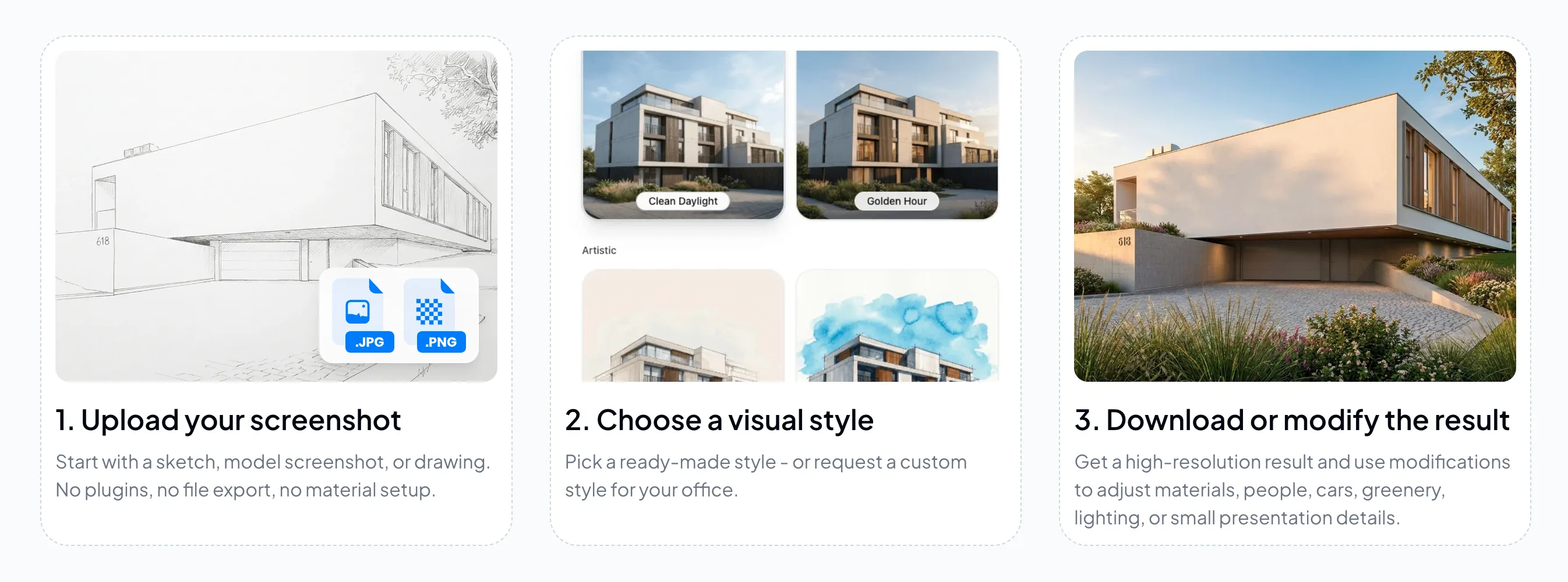
Step 1: Capture Your View
Take a clean screenshot of your active work viewport inside your preferred modeling software, such as Revit, SketchUp, Rhino, ArchiCAD, Blender, or another CAD/BIM tool.
Step 2: Set the Context
Upload the image to QuickArchViz. Select the desired material direction, weather condition, time of day, and presentation style using architectural terminology.
Step 3: Execute and Refine
Generate the base rendering in seconds. Use the two free iterations to polish material accents or environmental lighting before exporting the final image for a presentation deck.
ROI and Time-Savings Example
The JSON calculator idea in the brief translates into a simple studio ROI model.
| Metric | Traditional manual pipeline | QuickArchViz cloud workflow |
|---|---|---|
| Projects per month | 4 | 4 |
| Team size | 3 architects | 3 architects |
| Render setup time per image | 4 hours | 0.016 hours |
| Monthly production time | 48 hours | 0.2 hours |
| Time recovered | - | 47.8 hours |
| Estimated value at $75/hour | - | $3,585/month |
This is only an illustrative model, but it shows why total cost of ownership should include time, not only subscription pricing. The practical value is the ability to move billable hours back from technical production into active design work.
Procurement Checklist for Studio Directors
Before deploying an AI visualization tool across an active architecture firm, check the operational details that matter in production:
- Perspective lock: Does the tool keep the camera fixed when regenerating textures?
- Software compatibility: Can it process inputs from your modeling ecosystem without plugin maintenance?
- Predictable budgeting: Does the credit system support normal revision cycles?
- Architectural literacy: Are styles and material prompts grounded in real design language?
- Onboarding time: Can a new team member understand the workflow in ten minutes without prompt engineering training?
Business Impact and Value Realization
In professional architectural practice, rendering bottlenecks directly affect profitability. Local rendering pipelines can tie up workstations, slow delivery, and reduce the number of design options a studio can realistically present.
Moving rendering into an architect-optimized cloud workflow compresses the visualization timeline. Reducing turnaround from hours to under a minute lets teams explore more options, respond to client feedback faster, and reallocate production time to architectural design.
Elevate Your Studio’s Visual Pipeline
If your goal is to explore abstract, open-ended concepts across many preset digital styles, mnml.ai provides a capable environment for early experimentation.
If your goal is to integrate AI rendering into an active project delivery workflow where camera angles must remain fixed, building geometry cannot warp, and project budgets require predictable costs, QuickArchViz is the stronger fit for professional presentation work.
Create your QuickArchViz account and optimize your studio’s visualization workflow with fast, architect-first cloud rendering.
What Is mnml.ai?
mnml.ai is an AI-powered architectural visualization platform tailored for early-stage design exploration. Its public site positions the product around 12+ AI-powered rendering tools, 40+ architectural styles, and broad compatibility with sketches, model screenshots, CAD drawings, and rendering workflows.
What Is QuickArchViz?
QuickArchViz is a specialized cloud rendering workflow engineered for professional architectural presentation. Instead of functioning as an open-ended image generator, it acts as a non-destructive rendering layer that transforms raw viewport screenshots into photorealistic, presentation-grade assets while preserving structure, perspective, camera angle, and design intent.
Quick comparison
| Criteria | mnml.ai | QuickArchViz |
|---|---|---|
| Primary use case | Conceptual ideation and rapid style exploration. | Client presentations and fast rendering workflows. |
| Geometric fidelity | Best suited to visual exploration where small perspective changes are acceptable. | Built around structural integrity, geometry preservation, and fixed camera tracking. |
| Procurement fit | Suitable for individual designers, solo practitioners, and broad ideation workflows. | Engineered for architecture firms, studio managers, and professional presentation pipelines. |
QuickArchViz vs mnml.ai: Decision Matrix
| Feature / Vector | mnml.ai | QuickArchViz |
|---|---|---|
| Primary use case | Conceptual ideation and rapid style exploration | Client presentations and fast rendering workflows |
| Geometric fidelity | Useful for broad exploration; geometric consistency depends on the generated output | Strict structural integrity with fixed camera tracking |
| Development origin | Generalized AI architecture platform | Designed by RIBA-accredited architects |
| Iteration economy | Credit consumption depends on the platform plan and generation workflow | 1 Credit plus 2 Free Iterations per rendering pass |
| CAD/BIM integration | Manual upload of sketches, screenshots, CAD drawings, or model views | Optimized screenshot-to-render pipeline |
| Procurement fit | Individual designers, solo practitioners, and concept exploration | Architecture firms, studio managers, and delivery teams |
Choose mnml.ai if...
Choose QuickArchViz if...
Feature comparison
Geometry preservation vs stylistic fluidity
mnml.ai
mnml.ai is strong when stylistic variety matters most and the team wants to test a broad range of visual directions quickly.
QuickArchViz
QuickArchViz focuses on preserving the source building geometry, camera angle, depth, and structural alignment while generating materials, lighting, atmosphere, and context.
For brainstorming, stylistic fluidity is useful. For client presentations, geometric consistency is often non-negotiable.
Camera tracking and viewport consistency
mnml.ai
Broad generative workflows can be less useful when a formal design review depends on comparing Option A and Option B from exactly the same viewport.
QuickArchViz
QuickArchViz is designed to keep the camera viewport fixed so material, lighting, and landscape options can be reviewed side by side.
Fixed camera position keeps design comparisons credible.
Iteration economics and studio TCO
mnml.ai
The practical cost of an AI rendering platform depends on how many generations are required to refine an image until it matches the design intent.
QuickArchViz
QuickArchViz uses a structured iteration model: 1 Credit plus 2 Free Iterations, so teams can refine lighting, materials, and environmental details without spending a new credit each time.
Predictable revision cycles matter when a whole studio starts using AI rendering.
Pricing comparison
Total cost of ownership
The real cost of an AI visualization tool is not only the monthly plan. Studio directors should include generation credits, revision passes, failed outputs, onboarding time, local hardware savings, and the billable hours recovered when rendering no longer blocks active design work.
ROI example
With 4 projects per month, 3 architects, 4 hours of traditional render setup per image, and a $75 hourly billable rate, a studio can spend roughly 48 hours per month on manual rendering setup. A one-minute cloud rendering workflow for the same volume is roughly 0.2 hours, recovering about 47.8 hours of production time.
Use cases
Use mnml.ai when
You are in the first week of a competition or concept phase and want to test brutalist, minimalist, biophilic, futuristic, or abstract style directions before the design is fixed.
Use QuickArchViz when
You have a live model, a viewport screenshot, or a client deadline and need a polished visual that does not alter your architecture.
Use both when
The team wants broad ideation at the start, then a stricter geometry-safe presentation workflow once the design moves into client review.
Common alternatives
PromeAI
A broad AI design visualization platform often used for sketch-to-render and style exploration workflows.
LookX AI
An AI toolset for architecture and design visualization, often used for concept exploration and visual ideation.
Veras
An AI rendering workflow commonly used inside architecture pipelines for design visualization and model-based image generation.
FAQ
How does QuickArchViz maintain structural geometry?
QuickArchViz uses structural mapping layers that separate line work, perspective planes, and geometric depth from the stylistic rendering pass. This allows materials and lighting to change while the underlying architectural design remains unaltered.
Can I use QuickArchViz with hand sketches?
Yes. The sketch-to-render workflow is designed to recognize architectural linework and spatial composition, transforming hand-drawn concepts into structured visualizations while respecting the original layout.
What modeling software is compatible with QuickArchViz?
QuickArchViz works with clean viewport image exports and screenshots from modern BIM, CAD, and 3D tools, including Revit, SketchUp, Rhino, ArchiCAD, Blender, and 3ds Max.
How do the two free iterations work?
Every time you generate a new base rendering using one credit, QuickArchViz includes two modification passes. These can be used to fine-tune environmental details, lighting styles, or material options on the same view without spending additional credits.
Is mnml.ai better for early-stage conceptualization?
Yes. For loose, abstract brainstorming where the goal is to test divergent design styles without a fixed model structure, mnml.ai can be a flexible conceptual playground.
How long does a typical 4K render take on QuickArchViz?
Most high-resolution, presentation-ready visualizations are processed in under 60 seconds, offloading the rendering work from the local computer.
Elevate your studio's visual pipeline
Create client-ready architectural visuals from sketches, screenshots, CAD views, and BIM viewports with geometry-safe QuickArchViz rendering.
Create your first visualisations